Why do we go to music school at all?
In the classic teaching model the main goal of learning is technical mastery of the instrument in order to re-create written works. That goal gave us some of the highest achievements in European musical history, and at the same time it has cost us some of the effects that come with a broader understanding of music-making.
In our teaching model we see music-making as part of everyday life. Music does not belong only on a stage: we train students to use it as a tool for growing in listening and discipline, as a way of connecting their communities and as a tool for a playful relationship with the world.
Measuring success
Music exams often put students under great pressure, especially when they coincide with the end of the school year. On one hand a final exam is good motivation for thorough preparation; on the other, many students who look successful “on paper” end their musical path soon after finishing their education. So how do we secure measurable progress and at the same time make sure their education does not end in painful memories but continues into an active musical life?
To encourage steady progress, our students collect evidence of it in the form of progress badges. Week by week they develop skills in creating, performing, understanding, technical mastery, presenting and passing knowledge on, which equips them fully for an independent life with music. This way the mentor always knows where the student is on the path, and the student always has a colourful collection of weekly challenges to choose from.
Each badge becomes a little more demanding every year and increasingly turned outwards. After five years the student does not just acquire knowledge, they pass it on.
What about competitions?
In the classic model a student's excellence is shown through taking part in music competitions. Many reach outstanding results and recognition in the music world that way, while for many others that very competitiveness leads them away from playfulness, one of the main qualities of music-making.
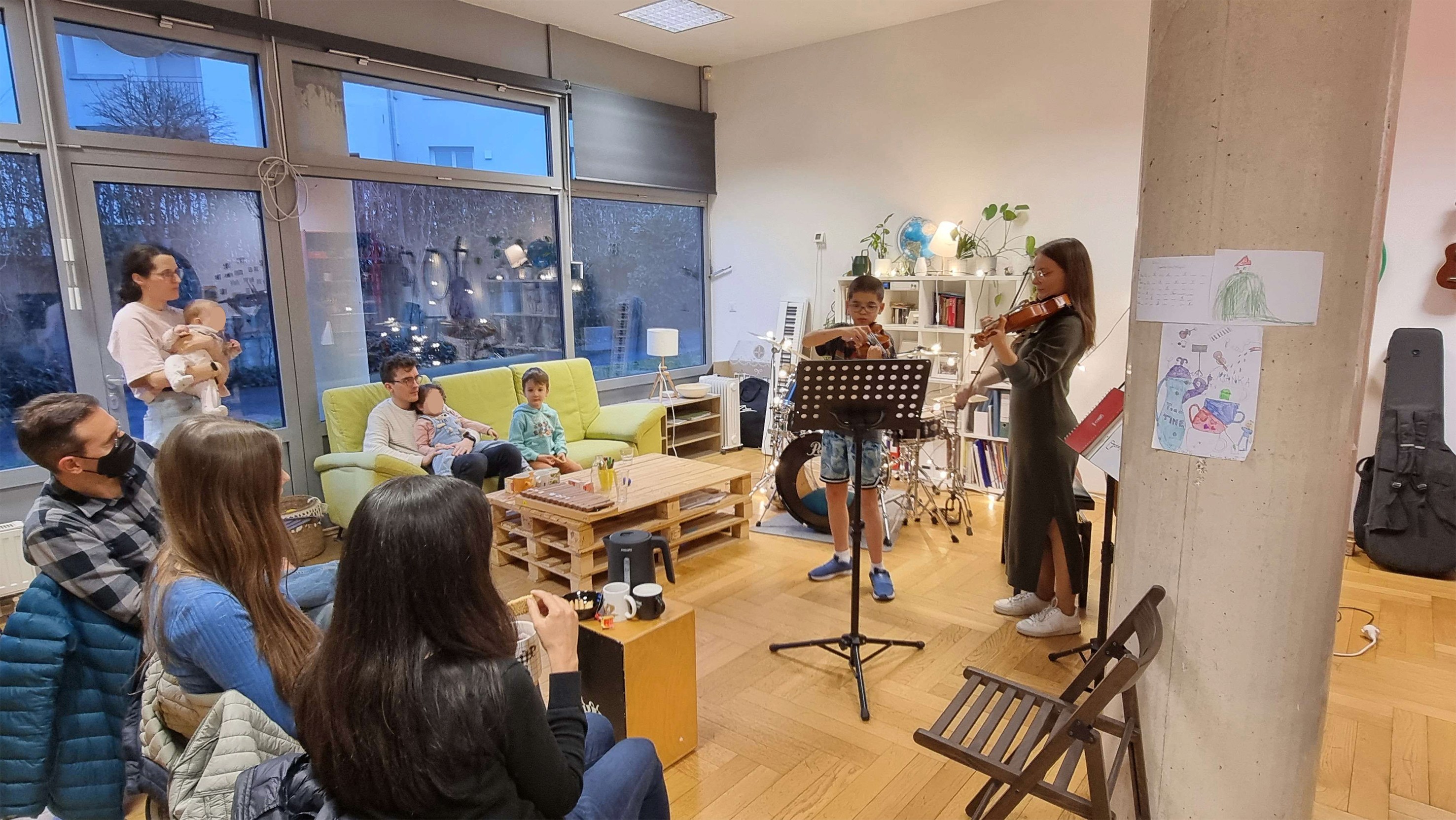
In our model students show their excellence by preparing an end-of-semester event. Because what they learn includes not only performing but also creating, recording and passing knowledge on, students present all of it to their family and friends at that event.
This turns the “exam” into a pleasant occasion that often includes simple refreshments and, above all, the company of people the student feels good around. One student prepares a Musical Tea Party, another adds music to a birthday celebration, a third puts on an Evening of Music and Poetry for family and friends.
What if I make a mistake?
In the traditional model mistakes are mostly treated as an unwanted by-product. That makes sense, since a mistake takes us further from the flawless performance that is the main goal of the classic model.
Our model of learning music follows the principles of language learning as described by the Canadian music educator Edwin E. Gordon. It all starts with listening. Imitation follows, and mistakes are an important part of the process too. Students refine their technique through a positive feedback loop of enjoyable experiences with music, with group music-making serving as an important source of motivation and of developing responsibility and reliability.
Only by experimenting in a safe zone can a student develop their own language, where a mistake is not merely an unwanted deviation but can become an important piece of the puzzle of musical creativity. That is why improvisation and getting to know other processes (recording, for instance) are an important part of learning here, introducing students to the playfulness of the creative process right from the start.
From experience we know that technical and theoretical refinement has to be backed, in good time, by a positive loop of enjoyable musical experiences.
The role of the environment
In the traditional model the student is at the centre of the process, with the family supporting their artistic development.
The goal of our process is for music to become the connective tissue of the community the student lives in, with the home as the primary musical venue.
That is why it matters that the student has the right conditions for musical growth - the chance to make music regularly, a family willing to join in from time to time, and support along the way. So that celebrations, family gatherings and visits are suitably joyful :)
So what now?
The simple truth is that no educational model answers every wish we have. If you are looking for a place for a student to develop as a concert performer, the classic model is an excellent choice. If, on the other hand, you want your children to use music to acquire practical life skills they can later apply in other areas, we invite you to look at the programmes we are preparing for our students next school year at conce.si/programi.